
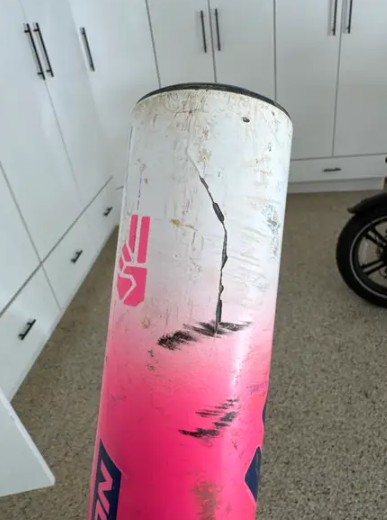
A high-end baseball bat is a significant investment, often costing north of $350. Naturally, parents want that investment to last as long as possible. However, every bat—whether alloy or composite—has a “life cycle.” Using a “dead” bat can kill a player’s confidence and stifle their performance at the plate.
Here is how to tell if your player’s favorite bat has finally lost its “pop” or if it’s just a temporary hitting slump.
- The “Sound” Test The easiest way to diagnose a bat is with your ears.
- Composite Bats: A healthy composite bat should have a distinct, crisp “crack.” If it starts sounding like a dull, hollow “clink” or a “crackling” noise (like a bag of chips), the internal layers may be delaminating.
- Alloy (Metal) Bats: A high-quality alloy bat should “ping.” If that ping turns into a flat, vibration-heavy “thunk,” the structural integrity of the metal has likely been compromised.
- The “Vibration” Indicator Is your player suddenly complaining that the bat “stings” their hands on every hit, even when they square the ball up?
- The Science: When a bat’s internal structure fails, it no longer absorbs the energy of the ball efficiently. That energy has to go somewhere, and it usually goes straight into the player’s palms. If “stingers” become a regular occurrence on solid contact, the bat is likely done.
- The “Visual” Inspection (Dents and Cracks) This seems obvious, but small defects are often missed.
- The “Flat Spot” Check: For alloy bats, run your hand slowly down the barrel. If you feel any flat spots or “waves,” the bat is officially illegal for play and has lost its “trampoline effect.”
- The “Spiderweb” Check: On composite bats, look for tiny “spiderweb” cracks in the paint. While some surface-level “spiraling” is a normal part of the break-in process, any crack you can stick a fingernail into means the bat is a safety hazard and needs to be retired.
- The “Rotation” Test If you aren’t sure, try the “Rotation Test.”
- The Method: Mark the top of the barrel with a piece of tape. Have your player hit 10 balls, rotating the bat a quarter-turn after every hit. If the ball flies significantly further or sounds different on one specific side of the bat, the internal walls are wearing unevenly.
The Bottom Line
Most high-end bats are designed to last about 1 to 2 seasons of heavy travel ball use. If your player has had the same bat for two full years and their exit velocity has plateaued, it’s likely time to move on. Don’t wait for the bat to literally break in half—replace it once the performance starts to dip.