
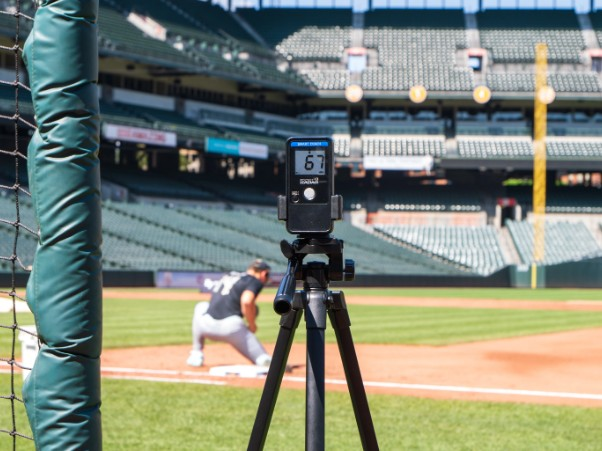
In the “Performance Lab” era of youth baseball, data is king. But for the average travel ball family, you don’t need a $20,000 Rapsodo unit to see results. The two most popular (and affordable) tools are the Pocket Radar and the Blast Motion Swing Sensor. Both provide incredible insights, but they measure completely different things.
If you only have the budget for one this season, here is how to choose.
- The Pocket Radar: Measuring Output The Pocket Radar (specifically the Smart Coach model) measures one thing perfectly: Velocity.
- What it tracks: Exit velocity off the bat and throwing velocity from the mound or infield.
- The Pro: It provides instant “validation.” A kid sees 65 mph on the screen and immediately wants to hit it 66. It is the ultimate tool for measuring raw power and arm strength.
- The Con: It doesn’t tell you why the ball went fast (or slow). It only measures the result.
- The Blast Motion: Measuring Mechanics Blast Motion is a small sensor that attaches to the knob of the bat.
- What it tracks: Swing speed, “Time to Contact,” and “Attack Angle.”
- The Pro: It analyzes the process. If your player is “long to the ball,” Blast Motion will show you exactly where the swing is breaking down. It’s like having a hitting coach in your pocket.
- The Con: The data can be overwhelming for younger players (8U-10U). It requires a bit more learning curve to understand the metrics.
The Verdict: Which one first?
- Buy the Blast Motion first if: Your player is struggling with consistency or “swinging through” the ball. It is a “diagnostic” tool that fixes mechanics.
- Buy the Pocket Radar first if: Your player already has a good swing but needs to build “intent” and explosive power. It is a “motivational” tool that builds “gas.”