
The 2026 Easton Hype Fire Review is the most anticipated update in the baseball world this year. After the 2025 model dominated the USSSA circuit, everyone wants to know if the new version maintains that massive barrel and signature pop. I’m looking past the neon paint to see if the performance actually justifies the $350+ price tag.
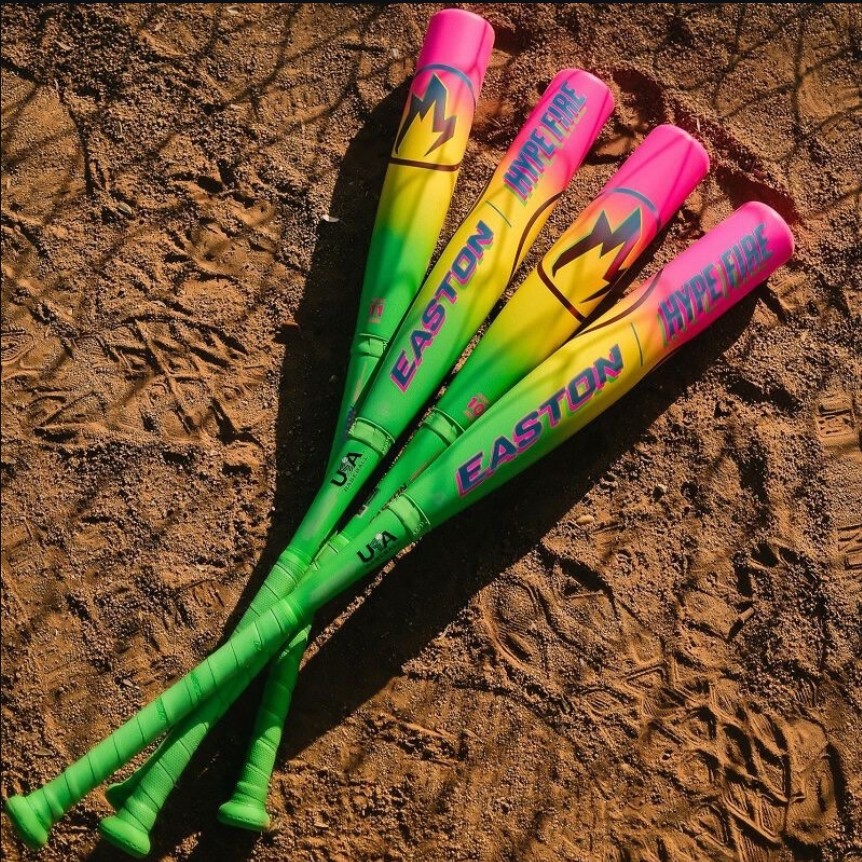
| Model Year | 2026 |
| Price | $349.99 (USA) / $399.99 (USSSA) |
| Certification | USA Baseball or USSSA 1.15 BPF |
| Construction | 2-Piece Composite (3D Ropecoil) |
| Drop Weight | -11, -10, -8, -5 |
| The Look | “Thermal” Neon Green to Hot Pink Fade |
The “Optimized” Sweet Spot: 3D Ropecoil Technology
One of the biggest upgrades in the 2026 Easton Hype Fire Review is the introduction of 3D Ropecoil Composite technology. Easton has essentially wrapped a three-dimensional composite rope 360 degrees around the center of the barrel.
Why does this matter for your player? It creates a “widened max performance area.” Instead of having one tiny sweet spot in the middle, the 2026 model allows for high exit velocities even on balls hit closer to the taper or the end cap. If your player is still developing a consistent swing, this tech helps turn what would have been a weak grounder into a hard line drive.
Durability Concerns: Is It Built to Last?
A common question in every 2026 Easton Hype Fire Review is whether the bat can handle a full season of travel ball without cracking. Because the barrel is designed with lower compression to be “hot out of the wrapper,” composite bats are naturally more fragile than alloy.
To maximize the life of your Hype Fire, avoid using it in temperatures below 60°F. In cold weather, composite fibers become brittle, which is when most cracks occur. Additionally, while it is “hot” immediately, we recommend a light break-in period of 100-150 swings of front toss before taking it into a high-velocity cage or game.
Who Is This Bat For?
The Hype Fire isn’t necessarily for every player in the dugout. It is a low MOI (Moment of Inertia) bat, meaning it has a very light swing weight. This makes it the perfect choice for:
- Contact Hitters: Who need elite bat speed to catch up to fast pitching.
- Developing Power Hitters: Who want the biggest possible sweet spot to maximize their strength.
- Elite USSSA Players: Who want the highest performing “hot” bat allowed by league rules.
If your player prefers a “stiff” feel or a heavy, end-loaded swing, they might prefer an alloy bat, but for pure performance and vibration dampening, the Hype Fire remains the king of the 2026 circuit.
Parent Perspective
Here is what you need to know before you swipe your card: The 2026 Hype Fire is arguably the ‘hottest’ bat allowed in youth ball, but it comes with a trade-off.
First, it is a performance-first bat. The thin barrel walls create massive trampoline effect, but they can be fragile in cold weather. If you live in the North, tell your player to keep this in the bag if it’s below 60°F—use an old alloy bat for those chilly early-spring practices instead.
Second, the 2026 tech is nearly identical to the 2025 model. If your player is still hitting well with last year’s bat, there’s no need to upgrade just for the new colors. However, if you’re jumping from a basic alloy bat to your first composite, this is the one that will give your player the most immediate confidence boost at the plate.
The Verdict
BUY (If you need a new bat and play in warm weather) or PASS (If you already own the 2025 Hype Fire)